REVIEW · MUSEUMS
Gyeongju UNESCO Sites Tour by KTX train; The Museum Without walls
Book on Viator →Operated by Tagytravelkorea · Bookable on Viator
A KTX morning turns Silla history into an easy day. I like the high-speed KTX round trip and how it keeps you from wrestling with long-distance travel. I also like that you get an English-speaking guide to translate the “what am I looking at?” moments. The one catch: it’s a long day, and a lot of it happens outdoors, so rain can make the pace feel harsher.
This is a private-style full-day sweep across Gyeongju’s UNESCO-level heritage: burial mounds, a star gazing tower, palace gardens, Korea’s famous Buddhist temple complex, and the cliffside Seokguram grotto. It’s built for people who want meaning, not just photos—one guided storyline from the old Silla kingdom to the sites you came to see.
In This Review
- Key points you’ll care about
- Why this KTX-from-Seoul setup is worth paying for
- The rhythm of a 7:00 am start and an 8–9 hour day
- Cheonmachong Tomb: the Silla burial mounds you can actually make sense of
- Gyeongju National Museum: context without a maze
- Cheomseongdae Star Gazing Tower: ancient astronomy with real details
- Donggung Palace and Wolji Pond (Anapji): palace gardens built for atmosphere
- Bulguksa Temple: the famous Silla Buddhist complex
- Seokguram Grotto: the grotto that looks over the East Sea
- Price and value: what $470 buys on this day trip
- Guide quality and the small moments that smooth the day
- Who should book this Gyeongju UNESCO day trip from Seoul
- Should you book the Gyeongju UNESCO Sites Tour by KTX?
- FAQ
- How long is the Gyeongju UNESCO sites tour by KTX?
- What time does the tour start in Seoul?
- Where is the tour located?
- Is hotel pickup included?
- Are round-trip KTX train tickets included?
- Is the tour private?
- Is an English-speaking guide included?
- Are admission fees included?
- Are meals included?
- Is there hotel drop-off service in Seoul?
- Can I cancel for a full refund?
Key points you’ll care about
- KTX round trip + private transfers: You’re picked up in Seoul and moved to your train and back, so you spend less time figuring logistics.
- Real time at major sites: The day is structured around six stops, with about an hour at each.
- English guidance at the hard parts: Tombs, observatory history, and temple art all make more sense with a guide’s explanations.
- Gyeongju National Museum included (and free on the tour): You get context without paying extra there.
- Seokguram and Bulguksa together: You’re seeing the temple complex’s key companion site, not picking one and missing the other.
- Meals aren’t included: You’ll want to plan your own lunch break timing.
Why this KTX-from-Seoul setup is worth paying for
If you’ve ever tried to squeeze Gyeongju into a day using public transport, you know the trap: travel time quietly steals the best parts of your day. This tour is priced at $470 per person, but the cost isn’t just for sightseeing—it’s mostly for removing the friction of getting there and back.
You’re traveling by KTX (economic class) with round-trip fare included, plus round-trip transfer by private vehicle for Seoul-area pickup. That means fewer parts to manage: your meeting time is set (7:00 am), and you’re not stuck trying to coordinate trains, transfers, and ticketing while also listening for Korean directions you don’t speak.
There’s also a practical benefit to the “private tour/activity” setup: it’s only your group, so the flow doesn’t get slowed down by random add-ons or lots of waiting around for other parties.
You can also read our reviews of more museum experiences in Seoul

The rhythm of a 7:00 am start and an 8–9 hour day
Start time is 7:00 am, and the whole experience runs about 8 to 9 hours. Each stop is roughly one hour, which keeps things moving. That’s good if you like momentum and want to cover key UNESCO-grade Silla heritage in one shot.
The possible downside is simple: you’re likely to feel it after a very early start. And since the itinerary includes palace gardens, tomb areas, and temple grounds, weather matters. One group note flagged that a heavy rain day can make outdoor stops less pleasant—so if forecasts look wet, bring a real rain jacket, not a sad little umbrella.
Pack for a full day: comfortable walking shoes, a light layer for early morning, and something small for sudden weather swings.
Cheonmachong Tomb: the Silla burial mounds you can actually make sense of
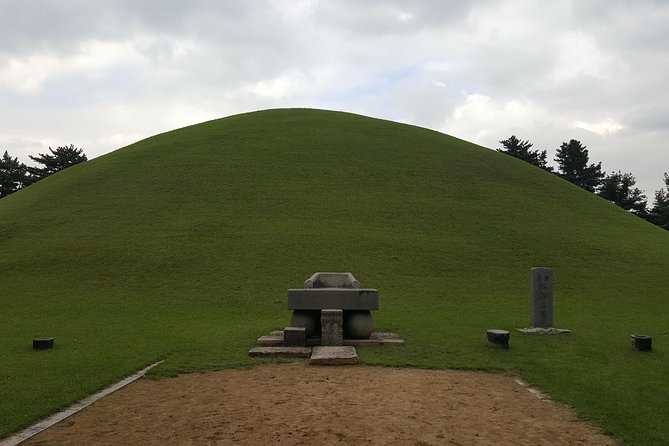
Your first stop is Cheonmachong Tomb, one of the Silla-era burial sites connected to the city’s royal and court history. This area includes more than 20 large and small tombs from the Shilla period. Most are earthen, mound-shaped, and the site is presumed to be connected to kings and court officials.
What I like about starting here is that it sets the tone fast. You’re not jumping straight to buildings—you’re learning how ancient Silla power marked people in the landscape.
What to do during your hour:
- Look at the way the mounds sit in the terrain. Even if you’re not an archaeology nerd, you’ll start to see the “designed burial landscape” idea.
- Expect that some tombs are likely to be simple mound forms while others may be different shapes. The tour description hints at variety, including gourd-shaped forms, which is a good sign you’ll get more than one “type” of burial structure on-site.
Gyeongju National Museum: context without a maze
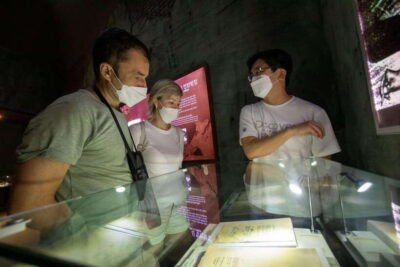
Next comes Gyeongju National Museum, a huge part of why this tour feels coherent. You get about an hour here, and admission is noted as free for this tour.
This museum is where you can understand why Gyeongju matters so much for Silla history—because you’re not only seeing sites, you’re seeing objects and exhibits tied to them. The museum’s main archaeological hall is highlighted as a strong “see it all at once” experience.
How to use your hour well:
- Don’t try to read everything. Pick a few anchor displays that match what you’ll see outside later in the day (temple art, royal objects, and Silla-era themes).
- If your guide points out symbols or what certain items were used for, pay attention. That’s the kind of explanation that makes later stops click.
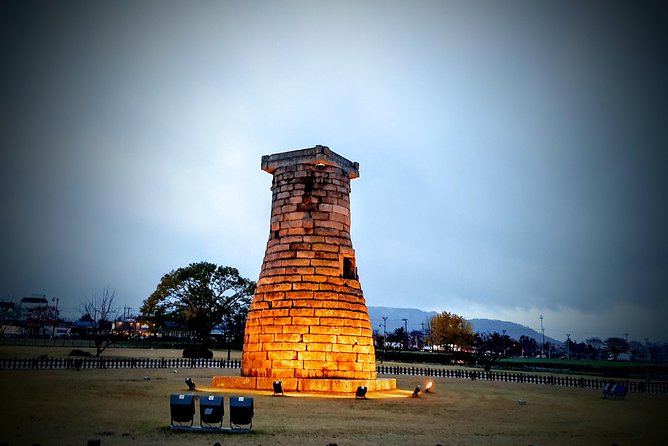
Cheomseongdae Star Gazing Tower: ancient astronomy with real details
Then you’ll head to Cheomseongdae Observatory, also called the Star Gazing Tower. The tour notes it was built during the reign of Queen Seondeok (the 27th ruler of the Silla dynasty), in 634. It also notes 27 levels of stones in the structure and calls it the oldest existing observatory in the Far East.
This is the stop where you’ll likely feel two things at once:
1) how old the concept of structured observation is, and
2) how much the Silla world cared about sky patterns.
Cheomseongdae is also a nice “lighter pace” moment in the day because it’s not a sprawling complex. You’re concentrating on one key structure and what it represented.



Donggung Palace and Wolji Pond (Anapji): palace gardens built for atmosphere
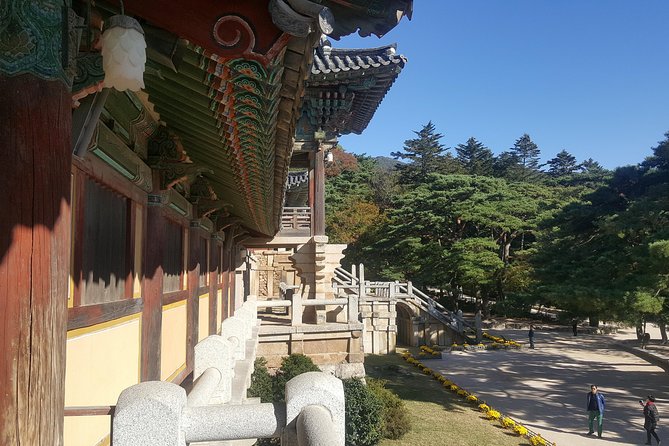
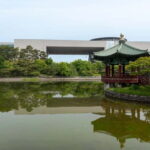
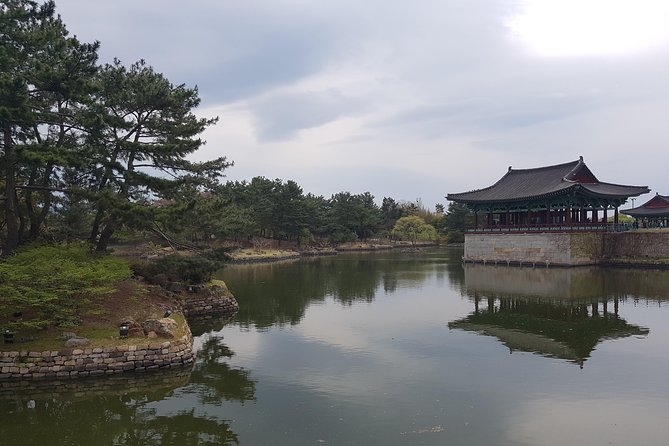
After the observatory, it’s Donggung Palace and Wolji Pond (the Anapji Pond). The tour describes it as palace space from 674, after the unification of the Korean Peninsula. It also mentions that mountains were created inside the palace walls, and that trees, flowers, and rare birds and animals were introduced to shape the setting.
That’s a big idea: this wasn’t just a pond. It was designed scene-making, the kind of environment you’d expect from a court trying to project power and taste.
You’ll spend about an hour here, with admission included. The practical win is that the pond area gives you a natural viewpoint for photos and a break from “structured stops” like museums and tombs.
The advice: take five minutes to step back and look at scale. When you do that, the description of artificial mountains and curated scenery starts to feel less abstract.
Bulguksa Temple: the famous Silla Buddhist complex
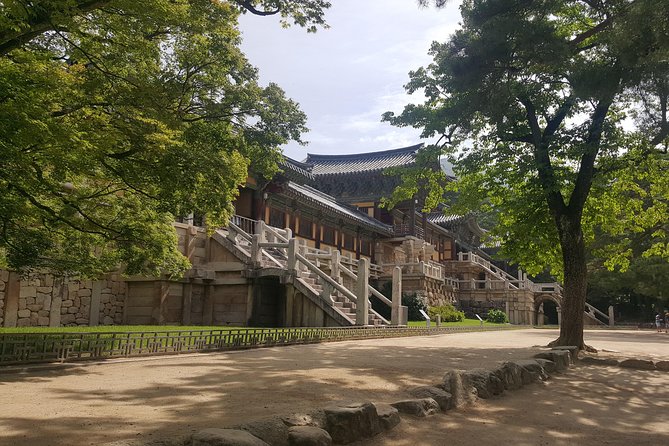
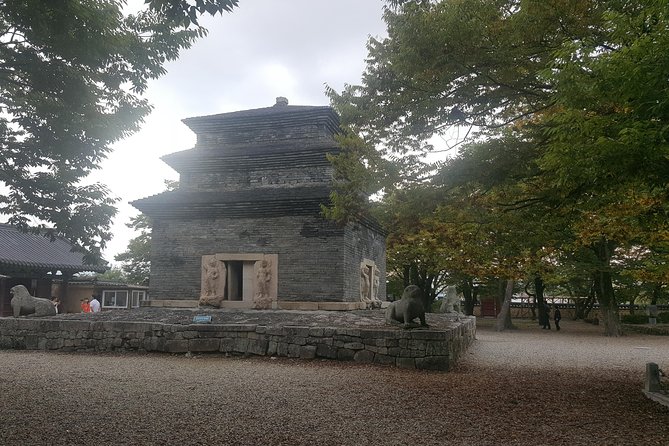
Your next major site is Bulguksa Temple, identified as the most famous Buddhist temple in Korea and home to important Silla-period relics. The tour specifically highlights two stone pagodas: Dabotap and another famous counterpart (the listing text cuts off, so I’m not going to guess the name). But it’s clear the pagodas are a key focus here.
Bulguksa is also where the tour becomes more than sightseeing. With a guide, you’ll usually learn what the structures symbolized, how they fit together, and why this complex is considered central for Korean Buddhist art.
This stop lasts about an hour, and admission is included. The likely reality: it’s a lot of walking and viewing from different angles. If you’re traveling with older relatives or anyone who gets tired easily, this is the point where a comfortable shoe choice really matters.
Seokguram Grotto: the grotto that looks over the East Sea
Then you’ll reach Seokguram, a hermitage part of the Bulguksa complex. The tour notes it overlooks the East Sea, sits at 750 meters above sea level, and holds some of the best Buddhist sculptures in the world (as the tour description frames it).
This pairing—Bulguksa plus Seokguram—makes the day feel complete. Many visitors see one and miss the other, and then the bigger story of the temple complex feels unfinished. Here, you get the companion site too, within the same guided schedule.
The practical part:
- You’ll likely feel the elevation difference as you move between stops.
- The main impression should be about the setting (hillside, sea view) and the sculpture focus.
Plan to slow down here even if the schedule is moving. This is the kind of place where your best photos happen when you stop trying to rush your way through.
Price and value: what $470 buys on this day trip
At $470 per person, this tour isn’t “budget day trip” pricing. But it’s also not just admission tickets in a fancy wrapper. Here’s what’s included in the cost:
- Hotel pickup in Seoul areas
- Private vehicle transfers to connect you to the train and back
- KTX round trip fare (economic class)
- An English-speaking guide
- All admission fees to the tourist sites on the tour
Two stops are noted as free on the tour side: Gyeongju National Museum and Cheomseongdae Observatory. That doesn’t make the tour cheaper, but it does reinforce that your money is going toward the guided package and the included major sites like Cheonmachong Tomb, Donggung Palace/Wolji Pond, Bulguksa, and Seokguram.
What isn’t included:
- Meals
- Hotel drop-off service in Seoul
So, if you want someone to handle transport, guide interpretation, and site entry costs in one organized package, you’re paying for that convenience. If you prefer DIY travel and you’re fluent enough to handle tickets and transfers alone, you may find cheaper ways. But the time saved is real.
Guide quality and the small moments that smooth the day
One of the strongest signals from the guide experience is not just knowledge, but how smoothly the day runs. On past outings with guides such as Jay, Dylan, John, and Andrew, the support included walking participants through the steps of getting to the right train seating and helping with the handoff between Seoul transit and the KTX.
That matters because the hardest part of a day trip isn’t the sites—it’s the transition points:
- meeting time
- getting onto the train
- finding your way inside a big station
When the tour team does that well, your sightseeing energy stays high.
There’s one balance point: one group noted that an accent made explanations harder to catch in a rainy, otherwise frustrating day. If you’re very sensitive to spoken clarity, I’d treat it like this: you’ll want to ask follow-up questions and make sure you can hear key points. Good guides usually adjust if you ask.
Who should book this Gyeongju UNESCO day trip from Seoul
This is a great match if:
- You want to see the Silla kingdom story in order, with a guide connecting tombs, astronomy, palace space, and Buddhist art.
- You’d rather pay for the logistics than spend your energy planning KTX timing and transfers.
- You like structured days where you get a clear lineup of top sites without guessing what comes next.
It may not be the best fit if:
- You hate early starts and a long day with limited breaks.
- You’re traveling when weather looks rough and you know you’ll be miserable walking outdoors.
- You’re determined to eat at specific restaurants and don’t want any flexibility around timing.
Should you book the Gyeongju UNESCO Sites Tour by KTX?
If your goal is to get a high-quality overview of Gyeongju’s UNESCO-level heritage in one day, I’d say yes, especially if the KTX logistics stress you out. The mix of Cheonmachong Tomb, Gyeongju National Museum, Cheomseongdae, Wolji Pond, Bulguksa, and Seokguram gives you the full Silla-style arc: power, learning, court life, and religion.
My deciding checklist for you:
- Check the weather. If rain is heavy, pack for it.
- Plan your own lunch since meals aren’t included.
- Wear shoes you can trust for temples and outdoor terrain.
- If you’re picky about guide pronunciation, be ready to ask a question or request repetition of the key points.
FAQ
How long is the Gyeongju UNESCO sites tour by KTX?
The tour runs about 8 to 9 hours.
What time does the tour start in Seoul?
The start time is 7:00 am.
Where is the tour located?
It’s a full-day tour of Gyeongju UNESCO sites, starting from Seoul, South Korea.
Is hotel pickup included?
Yes. Hotel pickup is included for Seoul areas.
Are round-trip KTX train tickets included?
Yes. Roundtrip transfer service with private vehicle and KTX round trip fare (economic class) are included.
Is the tour private?
Yes. It’s listed as a private tour/activity, and only your group participates.
Is an English-speaking guide included?
Yes. A local English-speaking guide is included.
Are admission fees included?
Yes. All admission fees to the tourist sites are included.
Are meals included?
No. Meals are not included.
Is there hotel drop-off service in Seoul?
No. Hotel drop off service (Seoul) is not included.
Can I cancel for a full refund?
Yes. You can cancel up to 24 hours in advance for a full refund.