REVIEW · HISTORICAL TOURS
Discover Seoul: Local Life and History
Book on Viator →Operated by MORTOUR GUIDED TOURS · Bookable on Viator
Seoul can feel like a slideshow of eras, but this walk makes it make sense. You’ll connect Joseon Dynasty landmarks with today’s Seoul through Gwanghwamun and Jongno-gu, including the big set piece: Gyeongbokgung Palace.
I like that the route is built for your first time in the city and keeps things practical, not just photo stops.
What I really like is the way the guide threads culture into your feet on the sidewalk. You’re not only looking at monuments at Gwanghwamun Plaza and Insadong; you’re also getting advice on what to drink and eat, including the famous Korean beer chicken.
One thing to consider: this is a walking tour, and the experience says it requires good weather. If rain is in the forecast, wear shoes you trust and keep an eye on the schedule offered by your operator.
In This Review
- Key things you’ll notice on this Seoul walk
- Seoul City Hall and Gwanghwamun: getting oriented fast
- Gwanghwamun Plaza statues: King Sejong and Admiral Yi Sunshin
- Gyeongbokgung Palace: Joseon power center and the guard change moment
- Insadong in hanok lanes: tea houses, crafts, and real eating advice
- Bukchon Hanok Village: walking up to traditional streets
- Price and value: what $96.75 gets you in 3.5 hours
- The guide factor: history, English, and practical food tips
- Logistics that matter: where to meet, how to move, and what to wear
- Who should book this tour, and who might want to skip it
- Should you book Discover Seoul: Local Life and History?
- FAQ
- How long is the tour?
- Where does the tour start?
- Where does the tour end?
- What areas and sights are included?
- Are admission tickets included?
- How big is the group?
- Is the ticket digital?
- What is the weather policy?
- Can I get a refund if my plans change?
- Is it suitable for most people and can service animals join?
Key things you’ll notice on this Seoul walk
- Small-group pace (max 20) that makes it easier to ask questions while you move.
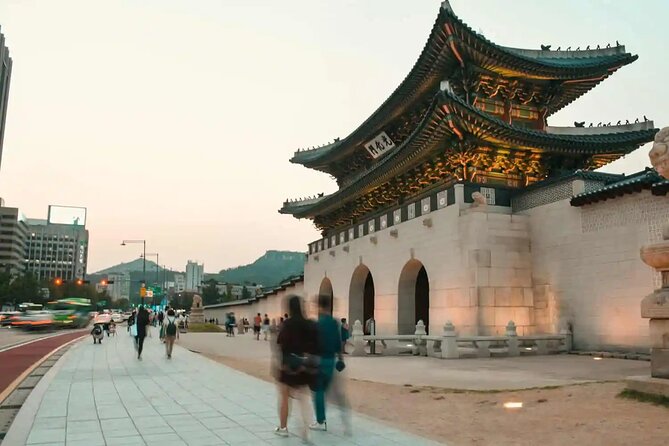
- Gyeongbokgung Palace + guard change as a clear focal point, not a random side stop.
- Gwanghwamun Plaza statues featuring King Sejong and Admiral Yi Sunshin right by the palace axis.
- Insadong’s hanok lanes where you can actually browse tea houses, galleries, craft shops, and casual bars.
- Bukchon Hanok Village on the hill for traditional streets with a preserved, long-time feel (about 600 years is referenced).
- Mobile ticket and a route designed around the main historic corridor, so you’re not constantly figuring out logistics.
Seoul City Hall and Gwanghwamun: getting oriented fast
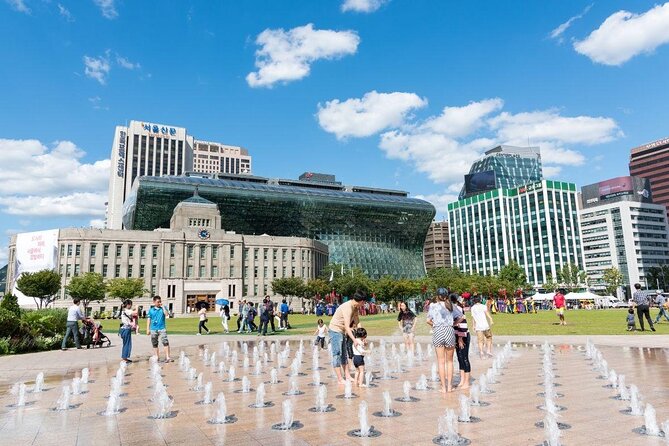
This tour starts in the Seoul Plaza area, with a stop at Seoul City Hall as your first piece of context. It’s a smart move early. City landmarks can feel abstract until you understand how modern Seoul grew around older power centers, and City Hall is a good place to get that frame.
From there you head to Gwanghwamun Square and the broad avenue that anchors the historic district. This is the kind of street where the scale of the city hits you: wide, organized, and built for major events and parades. It’s also where history gets visible without effort. You don’t need a museum ticket to start learning; the city layout itself helps explain the story.
A small practical note: the itinerary flags that City Hall could be closed on Tuesdays. If your dates include a Tuesday, don’t panic—your guide will still keep the day moving and cover the rest of the corridor as planned.
You can also read our reviews of more historical tours in Seoul

Gwanghwamun Plaza statues: King Sejong and Admiral Yi Sunshin
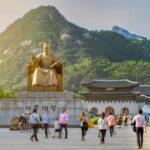
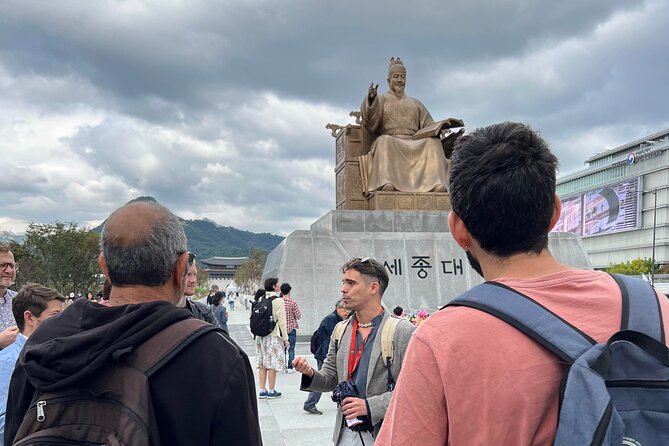
Right near the Gwanghwamun Gate area, you’ll pause at Gwanghwamun Plaza for a focused look at two Joseon-era figures: King Sejong and Admiral Yi Sunshin. These statues aren’t just for background photos. They’re a quick way to connect Korean identity to leadership, science, and defense.
Here’s what you should look for when you’re standing there: the placement and symbolism. This is the kind of public space where the city is telling you who it wants you to remember and why. When a guide points out what these figures represent, the names start to feel less like trivia and more like people with roles in a real historical system.
The time at this stop is short, so treat it like a gear-shift moment. Listen for the key connections your guide makes between Joseon priorities (governance, education, and naval strength) and the way Seoul presents itself today along this same axis.
Gyeongbokgung Palace: Joseon power center and the guard change moment
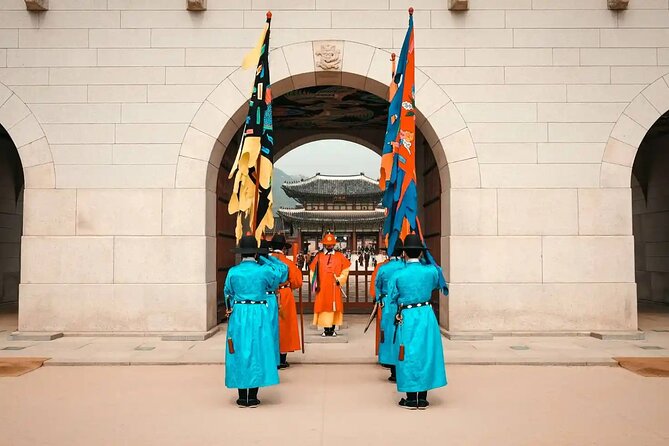
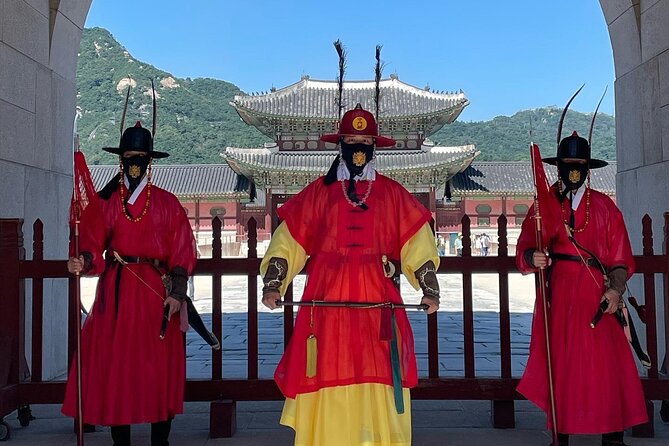
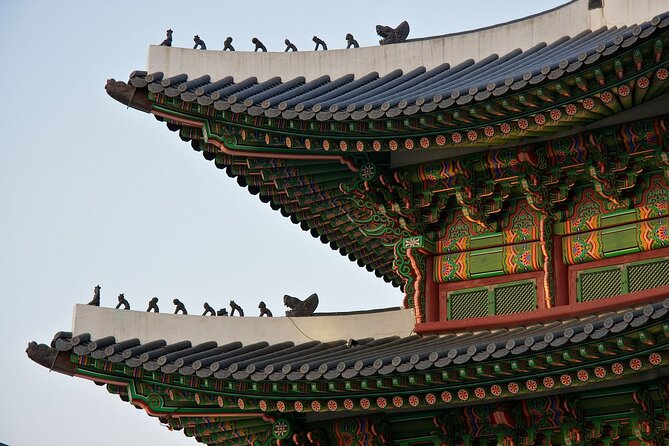
The heart of the walk is Gyeongbokgung Palace. Your visit includes an introduction to the main palace and the change of the guards, which is the one moment most people remember because it looks ceremonial and deliberate—even if you’re not fluent in Korean.
A palace can be overwhelming when you just arrive cold. What makes this stop useful is that you get the basic orientation first: what this palace was, why it mattered, and what you’re looking at as you move. Once you understand the palace layout at a high level, details like gate placement and building purpose start to click.
Also, the guard change is timing-sensitive. If you’re used to tours that rush through, you’ll appreciate that this one gives the palace a real chunk of time (about 30 minutes in the schedule). Still, if you’re photo-happy, keep your plan flexible—standing in one spot for the full ritual can block others, and guides usually encourage considerate viewing.
Even better: this is listed as free admission for the stop in the tour schedule. That matters for value. You’re paying for a guide and a route plan, not stacking ticket costs at every turn.
Insadong in hanok lanes: tea houses, crafts, and real eating advice
Once you’re done with the palace, the mood shifts to browsing. Insadong is one of Seoul’s older neighborhoods, and it’s the kind of place where you can actually spend time without feeling lost. The tour route includes Insadong specifically for its labyrinth of hanoks and the local shops that fill the space between them.
What you should expect here:
- Traditional tea houses where you can pause and reset
- Galleries and craft shops that make the area feel lived-in, not only staged for tourists
- Casual bars and small places where the vibe is easy and social
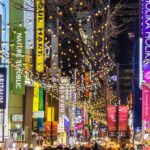
This is also where your guide’s food and drink tips become the most useful. The tour description highlights advice like where to find Korean beer chicken, and that kind of recommendation can save you a lot of trial-and-error in a neighborhood where the menus can be intimidating if you can’t read everything.
Drawback to keep in mind: Insadong streets can get busy, and with a group you’ll feel that momentum. If you want long, slow shopping time, you might not get it on the clock. But the tour gives you the right starting points—exactly what to look for when you come back on your own.
Bukchon Hanok Village: walking up to traditional streets
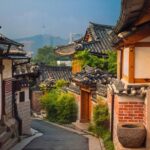
The tour finishes at Bukchon Hanok Village, specifically on the top of a hill between the palace area and Bukchon’s traditional zones. That hill location matters. You’ll feel the geography shift, and the views over Seoul are part of the payoff—even if the main purpose is cultural.
The tour schedule describes Bukchon as a Korean traditional village preserved to reflect a tradition reaching back roughly 600 years (as stated). Whether you’re standing in a narrow lane or looking down a row of rooftops, you’ll see what makes this place different from a themed district: it’s about the continuity of everyday streets and architecture.
Expect a gentle but steady walking component. This is not a sit-and-stare stop. Your best move is to look up and also look around. The rooftops tell one story, while the street angles and lane width tell another—how people moved and lived in a densely built area.
You’ll also finish at a café called Cafe Onion Anguk (listed as the end point), which is handy if you want a drink right after the walk. The posted opening hours shown for the end point are Monday to Friday, 10:00 AM to 5:00 PM, so plan timing around that if you’re thinking of lingering.





Price and value: what $96.75 gets you in 3.5 hours
At $96.75 per person for about 3 hours 30 minutes, this is priced like a solid, guided historic walk rather than a full-day excursion. The big value driver here is that the route concentrates on major sights in the Gwanghwamun/Jongno-gu corridor, so your money goes toward connecting dots.
Two value wins stand out:
- Admission is listed as free for multiple stops in the itinerary (City Hall, Gwanghwamun Square, Gwanghwamun Plaza, and Gyeongbokgung Palace, plus Insadong as shown). That can noticeably lower the total cost of doing this independently.
- The tour caps at 20 travelers, which usually means a smoother experience than big-bus chaos, especially in narrow hanok lanes.
If you’re traveling solo or you hate guessing which side of the street to start on, this price starts to feel more like efficiency than luxury. You’re buying a route plan, a narrative, and eating/drinking pointers that can help you get your bearings quickly.
One more practical angle: this tour is commonly booked about 24 days in advance on average. That doesn’t mean you must book far ahead, but if your schedule is tight around a first Seoul day, earlier booking helps you lock a slot.
The guide factor: history, English, and practical food tips
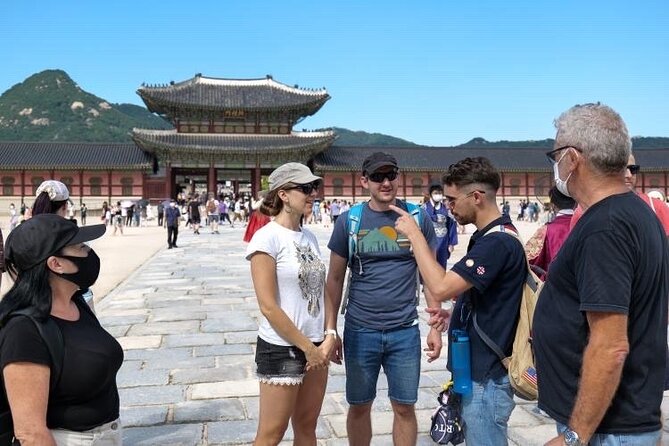
This tour really lives or dies by the guide, and the feedback you can expect to hear about this kind of program is consistent: a good guide turns monuments into a story you can repeat at dinner. The tour explicitly promises a mix of old and new Seoul, and in practice that usually comes through in the way the guide connects what you’re seeing—palaces, shrines/temple context along the way, statues, and market-style streets—to everyday life.
It also helps that the guide experience is described as strong in English in the reviews tied to this style of tour. Names that come up include Moises and Gemma, and both are described as knowledgeable and helpful. You’ll feel that when your questions get answered on the move, not after everyone disperses.
The other reason I like this tour style for a short visit: the guide doesn’t treat food as a side quest. The tour overview calls out tips on where to drink and eat, including beer chicken. That can be the difference between ordering the most tourist-friendly thing and ordering something you’ll actually crave again.
Logistics that matter: where to meet, how to move, and what to wear
You start at Seoul Plaza, 110 Sejong-daero, Jung District. The tour ends at Cafe Onion Anguk, 5 Gyedong-gil, Jongno District, with the walk finishing at Bukchon Hanok Village. Having a defined start and end matters because Jongno is a maze. Even if you later explore on your own, you’ll know where you ended up.
The tour uses a mobile ticket, which reduces hassle on the day. The schedule also says it’s near public transportation, so you shouldn’t need to plan for taxis just to begin.
Timing-wise, the tour runs about 3 hours 30 minutes. With multiple stops, you’ll want to dress for motion. Wear comfortable walking shoes and bring a light layer. Since the experience requires good weather, you’re better off preparing for sun or mild chill, then adjusting if rain is around.
If City Hall happens to be closed on your day, don’t interpret that as a missed experience. In tours like this, the guide typically shifts emphasis toward the other stops while keeping the main historic arc intact.
Who should book this tour, and who might want to skip it
This is a great match if:
- You’re on your first or second day in Seoul and want an orientation through the historic core
- You like history, but you don’t want a lecture. You want it attached to where you’re standing
- You want practical help with food and drink choices, not only sight descriptions
- You’re comfortable walking through neighborhoods like Insadong and Bukchon
You might skip it if:
- You want a slow, shopping-heavy day with lots of free time in one neighborhood. This tour moves as a group.
- You’re dealing with mobility limits. The route includes walking and a hill finish in Bukchon.
- Weather is a big question. The experience says it needs good weather, and cancellations due to poor conditions can move you to another date or refund you.
Also, because the group is capped at 20, it’s not a private tour. If you want total control over every minute, you’ll have to add your own extra exploration after the scheduled route.
Should you book Discover Seoul: Local Life and History?
If you’re the type of traveler who wants Seoul to click fast, I think this is a smart booking. The route is focused: Seoul City Hall to Gwanghwamun to Gyeongbokgung to Insadong to Bukchon. That’s a clean way to experience the city’s big historic spine while still getting local texture in hanok lanes.
At $96.75 for roughly 3.5 hours, the value improves if you take advantage of the guide’s practical advice on what to eat and where to linger. And with small group size, you’re less likely to feel lost or rushed.
If you’re visiting soon and weather looks uncertain, check plans and be ready for a date change if the operator cancels for poor conditions. But if the sky cooperates, this tour is one of the easiest ways to understand Seoul’s old-and-new rhythm without spending your whole day figuring it out.
FAQ
How long is the tour?
The duration is about 3 hours 30 minutes.
Where does the tour start?
It starts at Seoul Plaza, 110 Sejong-daero, Jung District, Seoul, South Korea.
Where does the tour end?
It ends at Cafe Onion Anguk, 5 Gyedong-gil, Jongno District, and the finish point is Bukchon Hanok Village.
What areas and sights are included?
The tour focuses on Gwanghwamun and Jongno-gu, including Seoul City Hall, Gwanghwamun Square, Gwanghwamun Plaza, Gyeongbokgung Palace, Insadong, and Bukchon Hanok Village.
Are admission tickets included?
The itinerary lists admission tickets as free for several stops, including Seoul City Hall, Gwanghwamun Square, Gwanghwamun Plaza, Gyeongbokgung Palace, and Insadong.
How big is the group?
The maximum group size is 20 travelers.
Is the ticket digital?
Yes, this experience uses a mobile ticket.
What is the weather policy?
The experience requires good weather. If it’s canceled due to poor weather, you’ll be offered a different date or a full refund.
Can I get a refund if my plans change?
Yes. Free cancellation is available up to 24 hours in advance of the experience start time for a full refund.
Is it suitable for most people and can service animals join?
The tour states that most travelers can participate, and service animals are allowed.