REVIEW · MORNING
Seoul Palace Morning Tour
Book on Viator →Operated by SEOUL CITY TOUR CO. LTD. · Bookable on Viator
Fast mornings, real Seoul history.
This 3-hour Seoul Palace Morning Tour strings together Jogyesa Temple, Gyeongbok Palace, and the Gwanghwamun Gate changing-of-the-guard ceremony, with hotel pickup and all entrance fees included. I like that you get a guided walk through the Joseon Dynasty’s key spaces without having to figure out tickets or logistics first thing in the day. The main trade-off: it’s a compact group morning, so the pace can feel brisk if you love lingering for photos.
What makes it work (and why it’s popular) is the guide style. The tour is set up with an informative, friendly, professional guide who can explain what you’re seeing as you move—like pointing out Jogyesa’s long-lived trees and the specific halls inside Gyeongbok Palace. In at least one departure example, a guide named Chloe shared stories all along the way and even helped with practical photo moments.
One more thing to know upfront: there’s an included stop at a ginseng center, and some people won’t feel great about that part. If shopping isn’t your thing, you can treat it as a short break and then focus on the palace and ceremony where the real value is.
In This Review
- Key highlights that make this tour worth considering
- A tight-morning sweep: Jogyesa, Gyeongbokgung, and the guard change
- First stop: Jogyesa Temple and the 500-year-old trees
- Blue House pass-by: what you can actually see
- Gyeongbok Palace highlights: throne hall to banquet suites
- Korean National Folk Museum: using palace time smarter
- Gwanghwamun Gate changing of the guard ceremony finale
- The ginseng center stop: good to know before you go
- Group tour reality: pace, communication, and how to make it smooth
- Price and value: is $40 for three hours a fair trade?
- Who should book this Seoul palace morning tour?
- Should you book the Seoul Palace Morning Tour?
- FAQ
- What time does the Seoul Palace Morning Tour start, and how long is it?
- Is hotel pickup included?
- What attractions are part of the tour?
- Are entrance fees included?
- Is lunch included in the price?
- Is there a shopping stop during the tour?
- Can I cancel for a full refund?
Key highlights that make this tour worth considering
- Jogyesa Temple’s 500-year-old locust trees and baeksong tree in front of the main hall
- Daeungjeon (built in 1938) and the Seokgamoni statue, plus a seven-storey stone pagoda
- Gyeongbok Palace hall-to-hall touring, including Geunjeongjeon, Sajeongjeon, and royal living quarters
- Korean National Folk Museum inside the palace grounds, where daily life and culture get explained
- Gwanghwamun Gate changing of the guard ceremony as a strong finale
- A scheduled ginseng center stop that can be great or annoying depending on your style
A tight-morning sweep: Jogyesa, Gyeongbokgung, and the guard change
This is the kind of morning tour that helps you get bearings fast. You start at 9:00 am with hotel pickup, ride in an air-conditioned vehicle, and then spend the rest of the time moving through three major “anchor” experiences: a major Zen Buddhist temple, Seoul’s most famous Joseon palace, and the guard ceremony at Gwanghwamun Gate.
At $40 per person for roughly three hours, the value isn’t just the sights—it’s the package. You’re paying for a guide, transport, pickup, and included entry fees, which means you’re not juggling multiple ticket lines or timing windows yourself. For many first-timers, that’s worth it even if they could theoretically visit some of these spots on their own.
The other reality check: this route is efficient. If you want a slow, read-every-placard kind of morning, you may feel the clock nudging you along. But if your goal is to see the highlights and keep moving toward lunch and exploring on your own, this tour matches that mindset well.
You can also read our reviews of more tours and experiences in Seoul
First stop: Jogyesa Temple and the 500-year-old trees
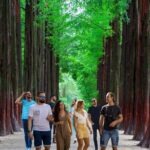
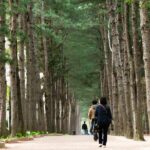
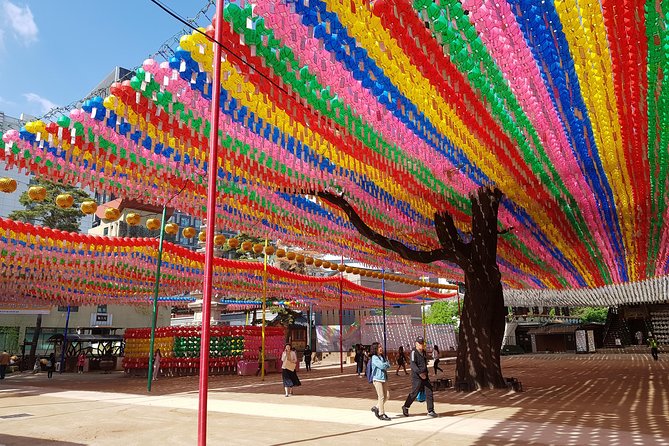
Jogyesa Temple is Korea’s best-known Zen Buddhism center, and it’s a smart opening stop because it gives you a totally different rhythm from the palace later. You’ll walk in and immediately notice the old trees in front of the main building area—locust trees and a baeksong tree that are about 500 years old. The baeksong tree is designated as a Natural Monument, which adds meaning to what can otherwise look like just scenery.
Inside the same early “wow” zone, you’ll get oriented around Daeungjeon, the main hall. The building itself dates to 1938 and is painted with multiple colors. It’s the kind of detail that’s easy to miss if you only breeze through. You’ll also see the statue of Seokgamoni inside the Daeungjeon building.
Then there’s the seven-storey stone pagoda in front of the hall area, built around Jinsinsari. Even if you don’t know the terms right away, having a guide connect the structure to what it represents makes the temple feel less like a landmark and more like a place with layers.
Practical note: temples mean walking on uneven ground and stairs, so wear shoes that don’t mind a little grit. Morning is usually the best time to do this kind of stop, before the city fully warms up.
Blue House pass-by: what you can actually see
After Jogyesa, you’ll go toward Gyeongbok Palace. One of the most talked-about moments is the Blue House area, the residence tied to South Korea’s leadership and government work.
Here’s the key point: security restrictions mean you cannot stop right in front of the Blue House. You’ll see it on the way—so think of this as a roadside glimpse, not a full photo-stop experience.
For me, that’s actually okay because it prevents you from wasting time. You get the context, you understand why it’s controlled, and then the tour moves on to the part that really rewards your time: the royal architecture and ceremony at Gyeongbokgung and Gwanghwamun.
If the Blue House is the main reason you booked, I’d set your expectations that this is more “see it from the route” than “stand in front of it.” The payoff is still the palace and the guard change.
Gyeongbok Palace highlights: throne hall to banquet suites
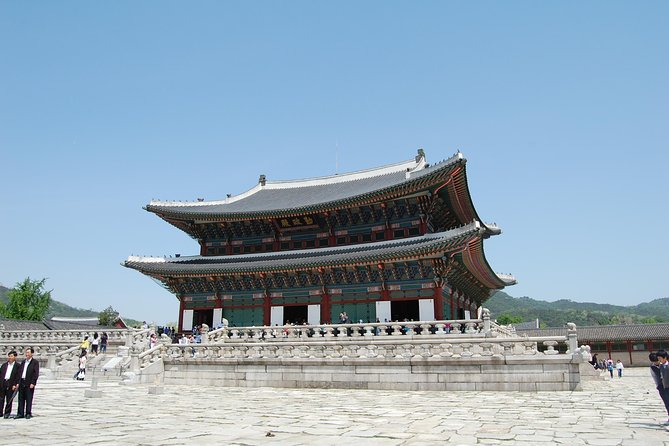
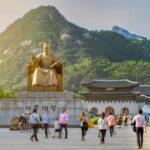
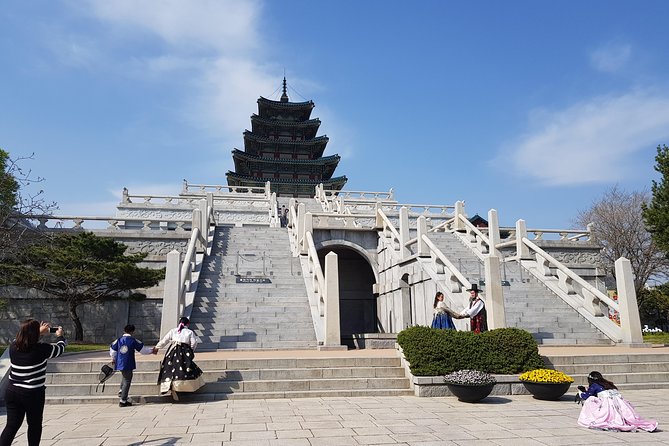
Once you reach Gyeongbok Palace, the tour shifts into full Joseon Dynasty mode. This is the city’s most famous and historic palace complex, and it’s famous for a reason: it’s massive, structured, and packed with specific buildings tied to different roles of the court.
Your guide will walk you through several key areas, including:
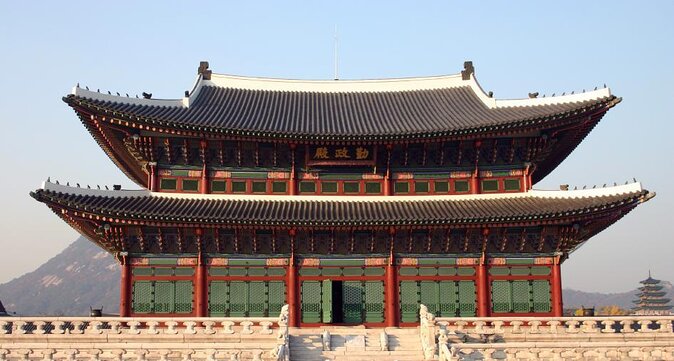
- Geunjeongjeon, the main throne hall
- Sajeongjeon, the king’s office
- Gangnyeongjeon, the king’s living quarters
- Gyotaejeon, the queen’s living quarters
- Gyeonghoeru, where formal banquets were held for foreign envoys
What I like about this approach is the way it helps your brain organize what you’re seeing. Instead of “here’s a courtyard, here’s another gate,” you get a sense of who used what space and why that building mattered. That turns a complicated palace into a guided story.
There’s also a big emotional shift when you get into the palace grounds: you’re moving from a spiritual site with centuries-old trees into a political and ceremonial center that shaped how power was displayed. Even the pace feels different because you’re surrounded by buildings built for public rituals and royal life.
One more practical tip: Gyeongbok Palace is not a sit-down experience. You’ll want a hat for sun, and you’ll benefit from keeping your phone charged because you’ll want photos from multiple angles. The good news is the guided structure makes it easier to know where to look.
Korean National Folk Museum: using palace time smarter
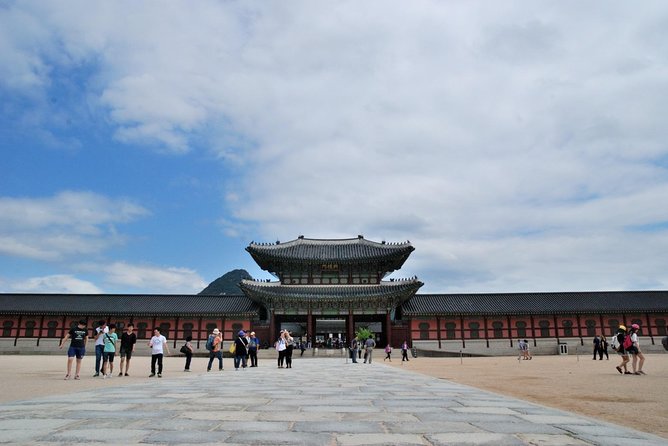
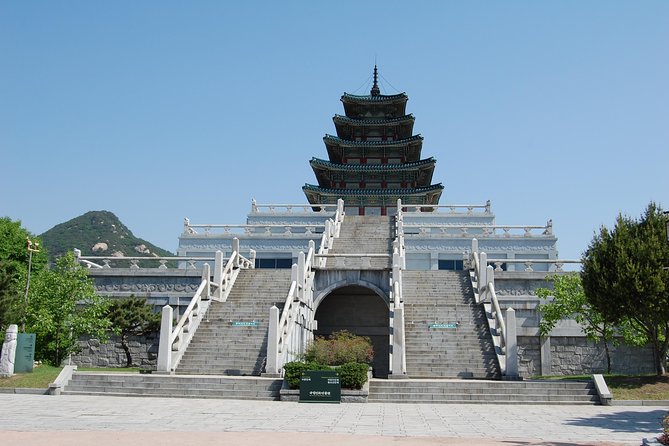
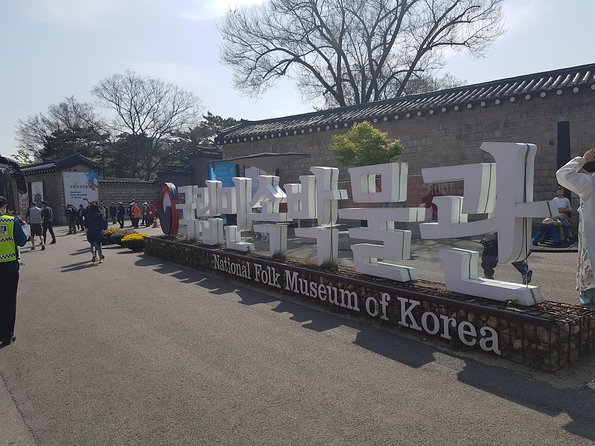
Inside the palace grounds, you’ll also visit the Korean National Folk Museum, which is built into the Gyeongbok Palace complex. This stop works best when you treat it as a “decoder ring” for what you’ve just seen outside.
The museum represents daily life and Korean culture, and it gives context for how people lived beyond the royal buildings. That matters because palaces can otherwise feel like sets—beautiful, but distant from real everyday routines.
If your mornings tend to be frantic, the museum is also a good reset. You’re still learning, but you’re not constantly walking. It adds depth without forcing you to extend the day.



Gwanghwamun Gate changing of the guard ceremony finale
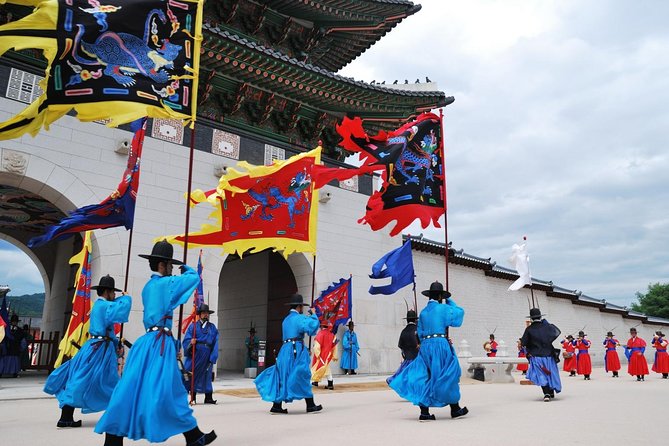
The tour ends at Gwanghwamun Gate, the south gate of Gyeongbok Palace, where you’ll see the changing of the guard ceremony. This is one of the strongest “stick with me” parts of the whole route because it’s visual and time-based—you can’t fully appreciate it from photos later the same way you can in person.
This is also where the tour’s timing matters most. If you arrive late because you stopped to take extra photos, you’ll feel it here. For the best experience, stay close to the group as you approach the gate.
I like that it makes a clean finish line. Once you see the ceremony, you’re done with the high-effort walking and you can shift your energy to lunch and wandering at your own speed.
The ginseng center stop: good to know before you go
One included stop is a ginseng center. It’s listed as one of the shopping centers included, and that’s where your experience can split depending on your preferences.
If you like learning about products and you don’t mind a sales-focused environment, it may feel like a cultural add-on—or at least a brief, organized break. If you’d rather spend every minute at the palace grounds, this can feel like time you wish you’d used elsewhere.
Either way, I’d treat it as a predictable part of the schedule. Plan for it mentally so it doesn’t throw off your morning. If you’re not shopping, consider it a short indoor interval, use the restroom if you need one, and then put your attention back on the palace and ceremony.
Group tour reality: pace, communication, and how to make it smooth
This is a group tour with a maximum of 30 travelers. That size is usually workable, but it means the guide has to keep everyone moving and keep the morning on track.
Some departures can feel quick—especially in how information is delivered—so the biggest way to improve your experience is to be ready for a guided sprint, not a leisurely stroll. That means:
- Wear comfortable shoes and expect walking.
- Keep your questions short and clear.
- If you care about photos, plan for them quickly rather than stopping to reset every two minutes.
Communication is another practical consideration. There have been cases where people had trouble getting a response in time before the tour or ran into confusion about pickup. The best defense is simple: confirm pickup details and be at the meeting/pickup spot a few minutes early, especially if your hotel is a maze of entrances or street lanes.
When the guide quality is strong, the pacing becomes a feature rather than a bug—because you’re hearing the right explanations at the right moments.
Price and value: is $40 for three hours a fair trade?
$40 for a three-hour morning tour can be a great deal if you value convenience and included access. Here’s why: hotel pickup is included, you ride in a vehicle, and entrance fees are covered. The tour also builds in multiple major sites that would be time-consuming to string together solo—temple, palace, folk museum, and a ceremony.
The value equation changes if you hate shopping stops or you’re sensitive to being rushed. In that case, you might feel like the ginseng center is the weak link for the time you’re paying for.
Still, if your goal is to hit top highlights efficiently and then keep the afternoon flexible, this price can make a lot of sense. It’s essentially buying yourself a guided route with built-in admissions, which is often the difference between seeing “some things” and seeing the real anchors.
Who should book this Seoul palace morning tour?
This tour fits best if you want:
- A structured introduction to Seoul’s major cultural sites in a single morning
- Included entry fees and hotel pickup to reduce first-day stress
- A guide-led explanation that connects temple spaces to palace spaces
- A clear endpoint at Gwanghwamun so you can continue exploring afterward
It’s less ideal if you:
- Want slow, unhurried time at each stop
- Really dislike shopping environments (because the ginseng center is part of the schedule)
- Need lots of personal customization during the walk (group pacing can limit detours)
Family-friendly is part of the pitch here, and because the tour is only about three hours, it can work for kids who can handle a morning out without needing a long sit-down.
Should you book the Seoul Palace Morning Tour?
I’d book it if you’re doing Seoul for the first time or you want a high-impact morning without spending time planning tickets and routes. The combination of Jogyesa Temple details (including those centuries-old trees), major Gyeongbok Palace halls, and the Gwanghwamun Gate ceremony is a very efficient way to understand what the city is proud of.
I’d think twice if you know you’re very price-sensitive but also very picky about schedule interruptions, because the ginseng center and group pacing can be frustrating if you’re not into that style of tour. If you can accept a brisk morning and treat the shopping stop as optional-in-spirit, the rest of the experience can feel like a smart, guided shortcut into Seoul’s cultural heart.
If you’re ready to walk, follow the guide, and then use the afternoon freely, this is a solid pick.
FAQ
What time does the Seoul Palace Morning Tour start, and how long is it?
It starts at 9:00 am and lasts about 3 hours.
Is hotel pickup included?
Yes. Hotel pickup is included, and the tour ends with drop-off at City Hall.
What attractions are part of the tour?
You’ll visit Jogyesa Buddhist Temple, see the Blue House on the way to Gyeongbok Palace, explore Gyeongbok Palace (including the Korean National Folk Museum), and finish at Gwanghwamun Gate for the changing of the guard ceremony. There is also a stop at a ginseng center.
Are entrance fees included?
Yes. All entrance fees are included, and free admission to top local attractions is included as well.
Is lunch included in the price?
No. Lunch is not included.
Is there a shopping stop during the tour?
Yes. One of the included shopping centers is the ginseng center.
Can I cancel for a full refund?
Yes. Free cancellation is available, and you can cancel up to 24 hours in advance for a full refund.